
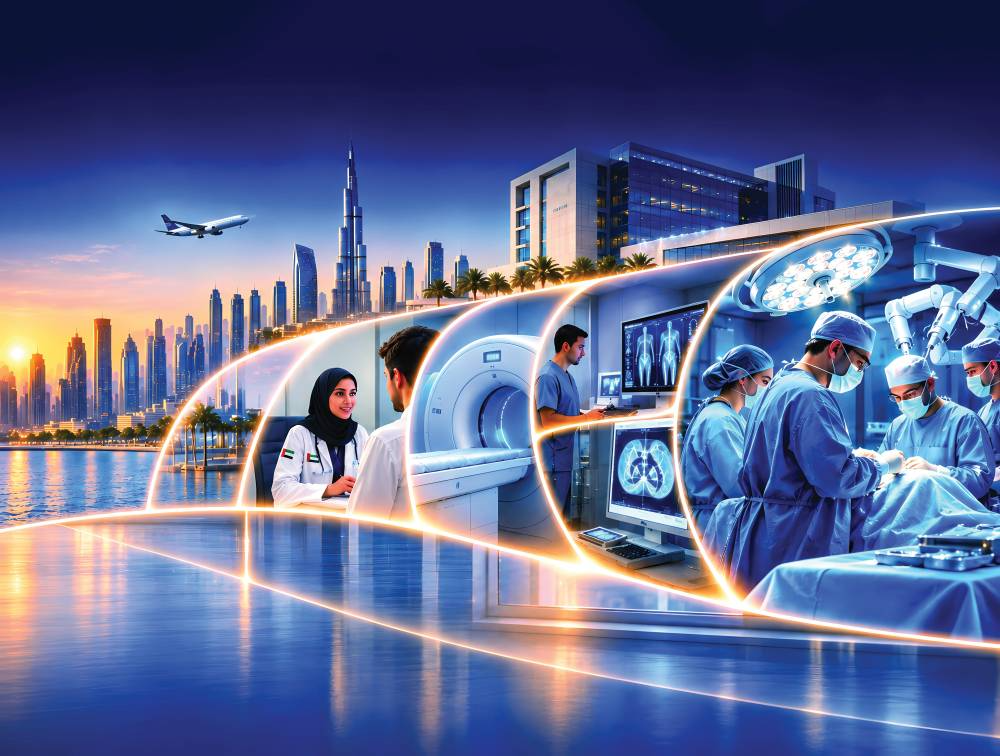
The United Arab Emirates continues to strengthen its position as a leading regional and global hub for healthcare and medical tourism, underpinned by world-class infrastructure.
The country attracts complex medical cases, with patients traveling specifically to undergo delicate surgeries and access advanced treatments—particularly in oncology, rare and genetic diseases, and precision medicine. This shift reflects the evolution of the UAE’s healthcare ecosystem and its expanding specialized capabilities, further cementing the nation’s standing on the global medical tourism map.
This transformation is driven by the expansion of healthcare infrastructure, investment in cutting-edge medical technology, and the recruitment of top-tier global talent. It is further supported by the seamless integration of healthcare and tourism services, alongside robust air connectivity. Increasingly, competition in the sector is shifting toward the quality of clinical outcomes, medical expertise, and the overall patient journey, rather than relying solely on cost-competitiveness.
Data from a report on UAE healthcare capacity for the second quarter of 2026, issued by the firm "Zaviss," reveals that there are 13,772 healthcare facilities across the country—including 173 hospitals and 6,854 clinics and health centers—comprising 18,500 hospital beds and 99,520 licensed healthcare professionals.
Meanwhile, the organization "BioNexus" estimates the value of the UAE’s healthcare market for the current year to be between $30 billion and $33 billion. This figure encompasses the full spectrum of activities within the health sector and is not limited to revenue generated by medical tourism alone. Health sector officials and specialists emphasized to *Al-Bayan* that the next phase requires building upon existing capabilities, strengthening partnerships among healthcare institutions, enhancing quality and transparency standards, and developing specialized services designed to attract international patients.
A Growing Infrastructure
Indicators from Dubai’s health sector highlight the significant expansion of its healthcare ecosystem. The number of licensed healthcare facilities in the emirate reached 5,931 in the first half of 2026—up from 5,541 during the same period in 2025—representing a 7% growth. Meanwhile, the number of licensed healthcare professionals rose to 70,566, compared to 66,277—an increase of 6.5%, according to data from the Dubai Health Authority.
The emirate also leverages its status as a global tourism hub; in 2025, it welcomed approximately 19.59 million international visitors—a 5% increase, according to the Department of Economy and Tourism. This creates opportunities to integrate tourism and medical services, though this figure does not specifically account for individuals arriving solely for medical treatment.
In Abu Dhabi, investments are increasingly directed toward precision medicine, oncology, the treatment of rare diseases, and gene therapies, as well as clinical research and medical applications powered by artificial intelligence. In 2025, a project was announced to establish the first heavy-ion therapy facility in the Middle East, located on the campus of Cleveland Clinic Abu Dhabi. This facility aims to provide an advanced cancer treatment technology, distinguished by its high precision in targeting cancer cells.
Dr. Jaffer Khan, founder and CEO of the clinics "Ion" and "Aesthetics International," stated that Dubai is entering a new phase of healthcare investment—one focused on developing health sustainability, preventive medicine, and early diagnosis. This shift opens broader horizons for attracting both investments and patients seeking specialized medical services.
He explained that Dubai’s health sustainability strategy, adopted in 2026, targets an annual growth rate of approximately 31% and an economic contribution exceeding AED 35 billion over the next decade. He noted that these figures represent strategic goals for the sector’s development, rather than investments or returns that have already been realized.
He emphasized that the success of this approach depends on providing evidence-based medical services, measuring outcomes, implementing clinical governance, and distinguishing between scientifically proven treatments and emerging technologies that still require further study.
Furthermore, he added that investment in health sustainability goes beyond merely extending lifespan; it aims to increase the number of years an individual spends in good health through prevention and early diagnosis. He highlighted the importance of advancing genomic testing and evaluating biomarkers related to metabolism and hormones, alongside investing in data systems and the training of medical personnel. Dr. Shanila Laiju, CEO of Medeor Hospital Group, stated that Dubai is increasingly attracting patients with rare and complex medical conditions, as well as families who travel specifically to access specialized treatments that may not be available in their home countries.
She explained that the international patients received by the group primarily come from the Middle East, Europe, Central Asia, and Southeast Asia. She noted that some patients—who might previously have sought care in the United States—are now choosing Dubai, thanks to the availability of advanced medical expertise and cutting-edge technology.
She added that the key medical specialties attracting patients include oncology, cardiology, neurosurgery, the treatment of rare diseases, and gene therapy. She pointed out that some complex cases require a stay of one to two months, depending on the nature of the condition and the specific treatment plan.
Furthermore, she emphasized that the treatment process begins even before the patient’s arrival, through remote medical consultations and the review of medical reports and test results, in order to assess the patient’s eligibility for treatment and to develop a comprehensive care and follow-up plan.
For his part, Suhail Atallah, Director of Clinical Operations at Mubadala Health in Dubai, stated that the emirate benefits from a combination of internationally accredited hospitals, modern technology, specialized medical expertise, and robust travel and aviation networks—all of which enhance its ability to attract patients from the Middle East, Africa, and South Asia. He explained that international patients seek high-quality care while avoiding long wait times, high costs, and the complexities of traveling to distant destinations, noting that gastroenterology, orthopedics, and rheumatology are among the key specialties offered by the institution.

