
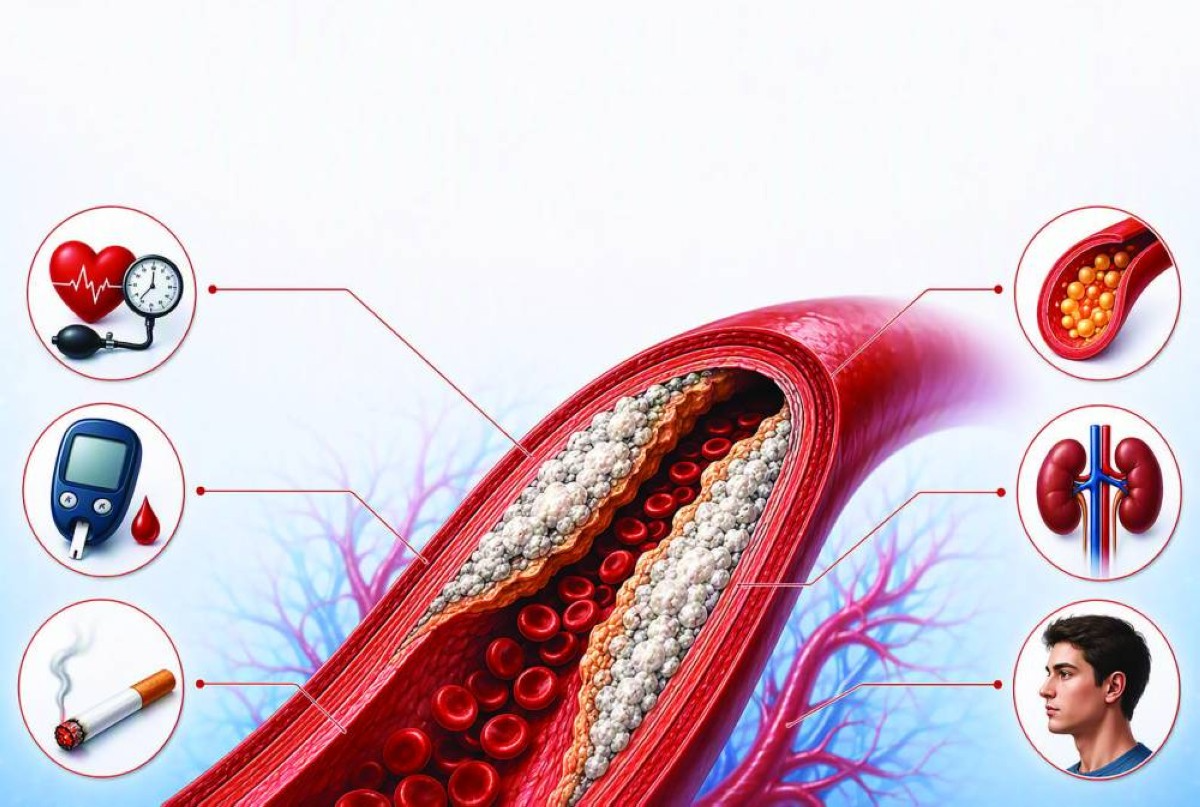
Cardiologists and cardiovascular surgeons have warned of a notable shift in the pattern of coronary artery calcification, as severe cases that were once predominantly observed in people over the age of 70 are now appearing in patients in their 40s and 50s, and sometimes even in their 30s. This trend is occurring amid a rise in early risk factors, most notably smoking, shisha use, diabetes, obesity, high blood pressure, high cholesterol and physical inactivity.
Specialists revealed that the danger extends beyond the disease affecting younger age groups. Calcification can progress silently without obvious symptoms, and some patients may reach advanced stages before the condition is detected. They stressed that severe calcification makes arteries stiffer and less flexible, increasing the difficulty of performing angioplasty and implanting stents.
Data from recent studies indicate that coronary artery calcification may be present in as many as one in 10 young adults, with the proportion potentially rising to around one-third among those with risk factors such as obesity, diabetes, high blood pressure and smoking.
Recent figures further highlight the scale of the challenge. More than 55,000 visits to cardiology services were recorded across facilities operated by the Emirates Health Services (EHS) in 2025.
Meanwhile, the Heart Centre at Al Qassimi Hospital recorded more than 2,150 cardiac catheterisation procedures, including 600 cases involving acute heart attacks, in addition to more than 164 cardiac surgeries. This was accompanied by the introduction of at least 70 advanced technologies used for the first time at the national and regional levels.
Doctors confirmed that advances in calcium-modification techniques and intravascular imaging have expanded treatment options for complex cases, making it possible to manage through catheter-based procedures conditions that were previously far more difficult to treat.
Advanced Technologies
Dr Aref Abdullah Al Noryani, Executive Director of Al Qassimi Hospital and Head of the Heart Centre, confirmed that cardiologists and interventional specialists have spent nearly two decades developing more effective solutions for treating severe arterial calcification. These advances aim to facilitate artery expansion and stent implantation while improving treatment outcomes.
He explained that one of the earliest techniques uses a rapidly rotating diamond-tipped device to modify hard calcium deposits inside the artery. Other techniques were subsequently developed, including a catheter that moves in a circular motion along the arterial wall to help break up calcium deposits.
He noted that intravascular lithotripsy, which uses shockwaves, has been an important addition in recent years. Based on a principle similar to that used to break up kidney stones, the technique delivers acoustic pressure waves inside the artery, creating cracks in hardened calcium deposits and making it easier to expand the artery and implant a stent.
Al Noryani revealed that the Heart Centre at Al Qassimi Hospital has adopted a new technology for the first time in the UAE. The technique uses a balloon covered with tiny metal hemispheres that concentrate pressure on specific points of calcification when the balloon is inflated inside the artery. This helps create cracks in the calcium deposits and prepares the artery for treatment.
He explained that more than four major techniques are now available to address arterial calcification, alongside cutting balloons equipped with tiny blades that create incisions in calcium deposits.
He also warned of a clear shift in the age profile of patients, noting that cases in the region are appearing at younger ages than those typically observed in Europe. Smoking and shisha use, he added, are major contributing factors to severe calcification among younger people.
“We used to see severely calcified cases more frequently in patients over the age of 70. Today, we are finding them in their 40s and 50s,” he said, adding that cases have also been identified in patients in their 30s. He stressed the need for further research to understand the reasons behind this shift.
Younger Patients
Dr Brajesh Mittal, Consultant Interventional Cardiologist, confirmed that coronary artery calcification is increasingly recognised as an important indicator of underlying coronary artery disease, and that attention to the condition is no longer limited to older adults.
He explained that diabetes, high blood pressure, high cholesterol, obesity, smoking and physical inactivity, in addition to a family history of premature heart disease, can contribute to the development of the condition at younger ages.
He noted that the increase in detected cases is not solely attributable to the growing prevalence of risk factors. Improvements in imaging, screening and early detection have also played a role, allowing doctors to identify cases that might previously have gone undiagnosed.
He emphasised the importance of assessing cardiovascular risk early in people with multiple risk factors and cautioned against assuming that heart disease affects only older age groups.
He explained that calcification occurs when calcium accumulates within plaque deposits in the walls of the arteries. As the disease progresses, arteries can become narrower and less flexible, restricting blood flow to the heart muscle.
Advanced cases, he warned, may be associated with angina, declining heart function and heart attacks. Early detection, however, allows for lifestyle modifications, appropriate medical treatment and intervention when necessary.
A Silent Disease
Dr Jan Niklas Streckling, Specialist in Interventional Cardiology and Consultant Cardiologist, said one of the most significant challenges associated with the disease is that calcification can be present without obvious symptoms, particularly in its early stages.
He explained that some patients discover the condition only during cardiac imaging examinations or after developing symptoms associated with reduced blood flow to the heart muscle.
Risk factors include high blood pressure, high cholesterol, diabetes, smoking, obesity, physical inactivity and a family history of arterial disease.
He urged people not to ignore chest pressure or pain, shortness of breath, unusual fatigue or a reduced ability to exercise. He emphasised that the absence of symptoms does not necessarily mean that the arteries are healthy.
He explained that the treatment of severely calcified arteries has advanced significantly through precise intravascular imaging, various calcium-modification techniques and procedures that prepare the artery before stent implantation.
These developments, he confirmed, have expanded physicians’ ability to treat cases that were previously extremely difficult to manage. However, the choice of technique continues to depend on the severity and location of the calcification, as well as the patient’s overall condition.
Dr Mohammed Abdul Moneim Mohammed Othman, Consultant Cardiologist, said the notable change is not limited to the number of cases but also involves the age of affected patients.
He explained that a decade ago, calcification was more commonly seen in patients aged 55 to 60 and older. Today, however, it is increasingly being detected in patients in their early 40s.
He linked this trend to the emergence of risk factors at younger ages, including diabetes, high cholesterol, high blood pressure, smoking, obesity and physical inactivity. He stressed that this shift calls for greater attention to prevention and early screening.
He explained that the amount of calcium in an artery does not always reflect the severity of its narrowing. A patient may have severe calcification without significant obstruction, while another may have substantial narrowing despite a different calcification burden.
He added that severe calcification makes artery expansion and stent implantation more difficult. It may prevent the stent from expanding adequately or cause injury to the arterial wall, making early detection and careful treatment planning particularly important.
He confirmed that some patients may have advanced calcification without symptoms, while chest pain, shortness of breath, fatigue and reduced exercise capacity are warning signs that require attention.
Dr Hisham Tayel, Consultant Cardiologist and Interventional Cardiologist, said arterial calcification is increasingly being detected in younger people due to the growing prevalence of risk factors and improvements in imaging techniques.
He explained that a large amount of calcium does not necessarily indicate a critical blockage, just as some patients may have significant arterial narrowing despite having a lower calcium burden.
He noted that treatment becomes more complex when calcification is severe, as it can prevent the artery from expanding adequately and hinder proper stent deployment. Early detection, he added, helps doctors manage blood pressure, diabetes and cholesterol, address smoking and reduce the risk of complications.
He confirmed that the disease can exist without symptoms and may be discovered incidentally during a CT scan. Chest pain, shortness of breath and fatigue may develop when blood flow to the heart muscle becomes compromised.
He added that advances in intravascular imaging and calcium-modification techniques have expanded the possibilities for treating complex cases through catheter-based interventions.
Dr Tamkeen Kanna, Consultant Cardiologist, said atherosclerosis can begin at an early age as a result of several interconnected factors. These include the rising prevalence of obesity, diabetes, high blood pressure, high cholesterol, smoking and physical inactivity. The wider use of CT scans has also helped identify more cases.
He explained that calcium in the arteries serves as an indicator of the overall burden of atherosclerosis, but does not necessarily directly reflect the degree of arterial obstruction.
He added that, in general, a higher calcium burden is associated with a greater long-term risk of cardiovascular disease, making early detection and control of risk factors essential.
He warned that leaving the disease unmanaged can lead to serious complications, including heart attacks, strokes and cardiovascular-related death.
Dr Jalal bin Saeed, Consultant Cardiothoracic Surgeon specialising in minimally invasive cardiac surgery and structural heart interventions, said calcification in people under the age of 45 is classified as premature calcification. This reflects an increased burden of risk factors among younger generations rather than simply improvements in detection methods.
He added that this shift is becoming increasingly evident in operating theatres, where surgeons are encountering severely calcified arteries in patients in their 40s and sometimes younger—cases that were less common in the past.
He noted that managing these cases requires more precise surgical planning and could eventually prompt a reassessment of the appropriate age at which certain preventive screening tests should begin.
Treatment Options
Dr Albert Al Ahmar, Consultant Interventional Cardiologist, said treatment options for severe arterial calcification have expanded in recent years.
He explained that key techniques include intravascular lithotripsy, which creates tiny cracks in calcium deposits to help the artery expand, alongside mechanical calcium-modification techniques, rotational atherectomy and orbital atherectomy.
He also noted that coronary laser atherectomy is used in selected cases. In addition, advanced intravascular imaging techniques help doctors assess the thickness and depth of calcium deposits and select the most appropriate device before implanting a stent.
Key Figures
55,000+
Visits to cardiology clinics across Emirates Health Services facilities in 2025.
2,150+
Cardiac catheterisation procedures recorded at the Heart Centre at Al Qassimi Hospital.
Read more at:

